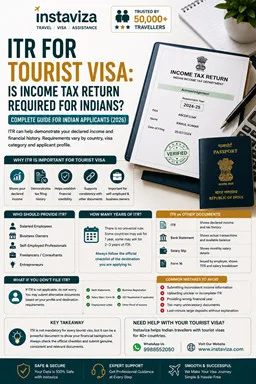
If you’re an Indian citizen planning an international holiday, you may have heard that Income Tax Returns (ITRs) are an important part of a tourist visa application.
But is ITR actually mandatory?
The answer is not for every tourist visa applicant.
ITR requirements vary depending on the destination country, visa category, applicant’s occupation, financial circumstances, and the specific document checklist.
However, for many Indian applicants—especially business owners, self-employed professionals, and applicants who need to demonstrate their financial history—ITRs can be valuable supporting documents.
In this guide, we’ll explain what ITR means in a tourist visa application, why it can be important, when it may be required, and what you should do if you don’t file an ITR.
What Is ITR?
ITR stands for Income Tax Return.
It is a return filed with India’s Income Tax Department containing information about a taxpayer’s income and other relevant tax information for a particular financial year.
For visa applications, an ITR can help provide evidence of your declared financial and income history.
It can be particularly useful for:
- Salaried employees
- Business owners
- Self-employed professionals
- Freelancers
- Consultants
- Entrepreneurs
The exact ITR documents required depend on the visa authority’s checklist.
Is ITR Mandatory for a Tourist Visa?
No. ITR is not universally mandatory for every tourist visa application.
Different countries have different requirements.
A visa authority may request:
- ITR acknowledgements
- Tax returns
- Bank statements
- Salary slips
- Employment letters
- Business financial documents
- Other proof of income
Some destinations may specifically request tax documents from self-employed or business applicants, while others may focus more heavily on bank statements and employment documents.
Therefore, you should always check the current requirements for the specific destination you’re applying to.
Why Is ITR Important for a Tourist Visa?
An ITR can help provide evidence of your financial background.
For example, it can help show:
Declared Income
Your tax return provides information about the income you have reported.
Tax History
It can demonstrate that you have a documented tax filing history where applicable.
Financial Consistency
Your ITR can be compared with other financial documents, such as bank statements and salary records.
Business Income
For business owners and self-employed applicants, ITRs can help explain income that doesn’t come from a traditional salary.
Who Should Consider Providing ITR?
Salaried Employees
A salaried applicant may provide ITRs as additional financial evidence where relevant or requested.
Other documents may include:
- Salary slips
- Employment letter
- Leave approval letter
- Bank statements
- Form 16, where applicable
Business Owners
ITRs can be particularly useful for business owners because they help document declared income.
A business owner may also provide:
- Business registration
- GST registration, where applicable
- Business bank statements
- Personal bank statements
- P&L statement
- Balance Sheet
- Business invoices
Self-Employed Professionals
Doctors, consultants, lawyers, freelancers, and other self-employed professionals may not have traditional salary slips.
Their ITR can therefore provide useful evidence of declared income when required or relevant.
How Many Years of ITR Are Required for a Tourist Visa?
There is no universal number of years that applies to every tourist visa.
Depending on the destination, you may encounter requirements for:
- Recent ITR
- ITR for the latest financial year
- ITR acknowledgements for multiple years
- Tax-related documents covering a specified period
Some applicants voluntarily provide several years of ITRs to demonstrate a longer financial history, but more documents are not automatically better.
The correct approach is to follow the destination’s official checklist.
ITR vs Bank Statement
Many applicants think these documents serve the same purpose.
They don’t.
ITR
An ITR provides information about your declared income and tax filing history.
Bank Statement
A bank statement shows actual transactions and account balances.
A bank statement can help demonstrate:
- Available funds
- Regular income credits
- Expenses
- Savings
- Financial activity
An ITR can help explain the broader income and tax background.
For some applications, both can provide useful complementary information.
ITR vs Salary Slip
These documents also serve different purposes.
Salary Slip
A salary slip generally shows monthly salary information, including earnings, deductions, and net pay.
ITR
An ITR provides information about income declared for the relevant tax year.
For a salaried applicant, providing both may help demonstrate consistency between employment income and declared tax information where relevant.
ITR vs Form 16
Form 16 and ITR are also different.
Form 16
Form 16 is issued by an employer to an employee and contains information related to salary income and tax deducted at source, where applicable.
ITR
The ITR is the taxpayer’s income tax return filed with the Income Tax Department.
Depending on the destination and checklist, one or both may be relevant.
What If You Don’t File ITR?
This is an important question for many applicants.
Not every Indian traveller will have an ITR.
For example, an applicant may not have filed an ITR because of their individual tax circumstances.
If ITR is not applicable to you, do not create, alter, or submit false documents.
Instead, determine whether the visa authority accepts alternative financial or professional evidence.
Depending on the applicant’s circumstances, alternative documents may include:
- Bank statements
- Salary slips
- Form 16
- Employment certificate
- Business documents
- GST registration, where applicable
- Business bank statements
- Other legitimate proof of income
The appropriate alternative depends on the destination and your circumstances.
Can I Apply for a Tourist Visa Without ITR?
Yes, in some circumstances.
Not every tourist visa application requires ITR.
The important question is whether the destination’s official checklist requires it for your particular applicant category.
If ITR isn’t required, you don’t necessarily need to submit one.
If it is required and you genuinely cannot provide it, you should determine what alternative evidence the visa authority accepts rather than submitting inaccurate documents.
Does ITR Prove That I Have Enough Money for My Trip?
Not necessarily.
An ITR shows declared income and tax information, but it does not necessarily show how much money you currently have available.
For example, an applicant may have earned a certain amount during a financial year but currently have a different bank balance.
This is why bank statements can be important where they are requested.
A strong financial file should accurately explain both:
- Your income history
- Your current financial position
Does a High ITR Guarantee Visa Approval?
No.
A high declared income does not automatically mean that a tourist visa will be approved.
Visa officers can consider multiple factors, including:
- Purpose of travel
- Financial circumstances
- Employment or business
- Travel history
- Professional and personal ties
- Supporting documents
- Overall credibility of the application
Financial strength is only one component of the assessment.
What If My ITR Shows Low Income?
A lower declared income does not automatically mean that a visa will be refused.
However, your application should realistically explain:
- Who is paying for the trip
- Your available funds
- Your employment or business situation
- The expected cost of travel
- Any legitimate financial support
If someone else is sponsoring the trip, appropriate sponsor documentation may also be relevant depending on the destination.
The important thing is that the information across your application remains consistent.
What If My Bank Balance Is Much Higher Than My ITR Income?
This can happen for legitimate reasons.
For example, your bank balance may include:
- Previous savings
- Business income
- Investment proceeds
- Property sale proceeds
- Family transfers
- Other legitimate sources
However, significant or unusual transactions should be explainable and supported by genuine documentation where appropriate.
A visa application should not rely on unexplained last-minute deposits simply to create an artificial bank balance.
ITR for Self-Employed Applicants
For self-employed applicants, ITR can be particularly useful because they may not have conventional salary documentation.
A self-employed visa file may include:
- ITR
- Business registration
- GST registration, where applicable
- Personal bank statements
- Business bank statements
- Financial statements
- Business invoices
- Contracts
- Cover letter
The exact combination should depend on the destination.
ITR for Business Owners
Business owners may have more complex finances than salaried applicants.
Their financial profile can include:
- Business revenue
- Salary or remuneration
- Dividends
- Investments
- Business assets
- Personal assets
An ITR can help connect the applicant’s declared income with their overall financial documentation.
However, it should be submitted alongside the documents actually requested by the visa authority.
ITR for Freelancers
Freelancers often don’t have:
- Salary slips
- Employer letters
- Traditional leave approval
Their financial documentation may instead include:
- ITR
- Bank statements
- Client invoices
- Contracts
- Payment records
- Professional registration, where applicable
- Portfolio or business website
Again, requirements vary by destination.
Common ITR Mistakes in Tourist Visa Applications
1. Submitting Inconsistent Income Information
Your ITR should not contradict your bank statements or other financial records without a reasonable explanation.
2. Providing the Wrong Financial Year
Check exactly which period the visa authority is requesting.
3. Uploading Unclear Documents
Make sure your ITR acknowledgement and related documents are readable.
4. Assuming More ITRs Are Always Better
Don’t overload the application with irrelevant documents.
Submit the documents that support your circumstances and satisfy the checklist.
5. Ignoring Changes in Income
If your income has changed significantly, your application should accurately reflect your current circumstances.
How to Prepare Your ITR Documents for a Tourist Visa
Before applying:
Step 1: Check the Official Checklist
Find out whether ITR is required for your applicant category.
Step 2: Identify the Requested Period
Check whether the authority wants one year or multiple years.
Step 3: Download Clear Copies
Use complete and readable documents.
Step 4: Compare With Other Financial Records
Check consistency with:
- Bank statements
- Salary slips
- Form 16
- Business financial statements
Step 5: Explain Genuine Differences
If there are legitimate differences between documents, prepare appropriate supporting evidence or an explanation where necessary.
Example: Salaried Employee
An employed Indian applicant planning a holiday may have a financial file containing:
- Passport
- Employment letter
- Leave approval
- Salary slips
- Personal bank statements
- ITR, where required or relevant
- Form 16, where appropriate
- Travel itinerary
- Accommodation documents
The exact requirements depend on the destination.
Example: Business Owner
A business owner may have:
- Passport
- Business registration
- GST registration, where applicable
- ITR
- Business bank statements
- Personal bank statements
- P&L
- Balance Sheet
- Business invoices
- Cover letter
- Travel documents
Again, the applicant should follow the official requirements rather than submitting every document available.
Example: Self-Employed Professional
A self-employed professional may use:
- ITR
- Personal bank statements
- Business registration, where applicable
- Professional registration
- Client contracts
- Invoices
- Business bank statements
- Other relevant financial records
The purpose is to demonstrate a genuine professional and financial profile.
Should You Submit ITR Even If It Isn’t Required?
Not necessarily.
There is a common misconception that adding more financial documents automatically strengthens a visa application.
The better approach is to submit relevant, genuine, and consistent documents.
If ITR isn’t requested but is useful for explaining your financial circumstances, it may sometimes be included as supporting evidence. However, the decision should depend on the destination’s requirements and the overall structure of your application.
ITR can be an important financial document for Indian tourist visa applicants, especially business owners and self-employed professionals, but it is not universally mandatory.
Your ITR can help demonstrate declared income and tax history, while bank statements can show current financial activity and available funds.
Neither document should automatically replace another document that the visa authority specifically requests.
Before applying, check the latest official requirements for your destination and prepare a document set that accurately reflects your employment, business, income, and financial circumstances.
If you need help preparing your tourist visa documentation, Instaviza assists Indian travellers, business owners, freelancers, entrepreneurs, and self-employed professionals with tourist visa applications for 40+ countries.
WhatsApp: 9988552050
Website: www.instaviza.com
Frequently Asked Questions
No. ITR is not mandatory for every tourist visa. Requirements depend on the destination, visa category, and applicant profile.
There is no universal requirement. Some destinations may request recent ITRs or multiple years of tax documents. Follow the specific checklist for your destination.
Yes, depending on the destination and your circumstances. If ITR is not applicable or not requested, other legitimate financial documents may be used where accepted.
Generally, no. ITR shows declared income and tax information, while a bank statement shows actual transactions and available balances.
Not necessarily. If ITR is specifically required, a bank statement should not automatically be treated as a replacement.
It may be requested or useful for self-employed applicants, but requirements vary by destination.
It can be an important supporting financial document, particularly when the applicant’s income comes from a business. The exact requirement depends on the destination.
This can happen for legitimate reasons. You should be able to explain the source of your funds and provide genuine supporting documents where appropriate.
No. Visa decisions are based on the complete application, not just income or tax records.
Yes, where relevant. Freelancers can use ITR alongside other documents such as bank statements, invoices, contracts, and professional records.
Not automatically. Consider whether it adds relevant support to your application and follow the destination-specific requirements.
Instaviza provides tourist visa assistance and documentation guidance for Indian travellers. Tax documents should always be genuine and prepared or filed through the appropriate channels.

Author: Visa & Travel Desk – Instaviza
The Visa & Travel Desk at Instaviza is a team of experienced visa documentation specialists and travel consultants who track global immigration policies, embassy announcements, airline advisories, and international travel regulations affecting Indian travellers. With years of experience assisting Indian passport holders with tourist visas, passport services, and travel insurance, Instaviza is committed to publishing accurate, reliable, and up-to-date travel information. Content published under Instaviza’s Editorial Policy.