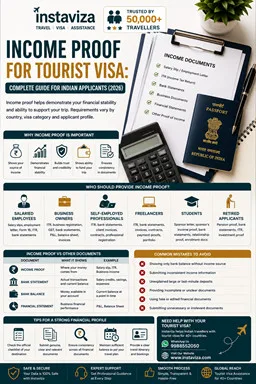
When applying for a tourist visa, one of the most important questions is often:
How will you pay for your trip?
Visa authorities may ask applicants to provide income proof and other financial documents to understand their financial circumstances and whether they can reasonably afford the proposed trip.
For Indian applicants, income proof can look different depending on whether you’re a salaried employee, business owner, self-employed professional, freelancer, student, homemaker, or retired person.
There is no single income-proof document that works for everyone.
Your financial documents should accurately reflect your actual circumstances.
In this guide, we’ll explain what counts as income proof for a tourist visa, which documents different applicants can use, how income proof differs from bank balance, and the common mistakes you should avoid.
What Is Income Proof for a Tourist Visa?
Income proof is documentation that helps demonstrate where your money comes from and how you financially support yourself.
Depending on your employment or professional status, income proof may include:
- Salary slips
- Income Tax Returns (ITR)
- Form 16
- Employment certificate
- Bank statements
- Business financial statements
- Business bank statements
- Client invoices
- Contracts
- Pension statements
- Other legitimate proof of income
The exact documents required depend on the destination and your individual circumstances.
Why Is Income Proof Important for a Tourist Visa?
A tourist visa application generally needs to present a credible financial picture.
Income documents can help demonstrate:
1. Your Source of Income
They can show whether you earn money through:
- Employment
- Business
- Freelancing
- Investments
- Pension
- Other legitimate sources
2. Financial Stability
Regular income can help explain how you support your lifestyle and travel expenses.
3. Ability to Fund the Trip
Your income, savings, and expected travel costs should make sense together.
4. Consistency
Income information can be compared with your bank statements, ITRs, salary slips, and other documents.
Is Income Proof Mandatory for Every Tourist Visa?
Not necessarily in the same form.
Different countries have different financial documentation requirements.
Some may request:
- Bank statements
- Salary slips
- Employment documents
- Tax returns
- Proof of business
- Sponsor documents
Others may have specific financial requirements or minimum funds.
The important point is that you should not use a generic financial checklist for every country.
Always check the current official requirements for the destination and visa category.
Income Proof for Salaried Employees
Salaried employees generally have one of the easiest income profiles to document because their income is supported by employer records.
Common documents may include:
Salary Slips
Recent salary slips can demonstrate regular monthly income.
Employment Letter
An employment letter can confirm:
- Job title
- Employment status
- Date of joining
- Salary, where included
Salary Certificate
A salary certificate can formally confirm your current salary and employment details.
Bank Statements
Bank statements can demonstrate regular salary credits and current financial activity.
ITR
ITR can provide additional evidence of declared annual income and tax history where relevant or requested.
Form 16
Form 16 can provide supporting information relating to salary income and tax deducted at source, where applicable.
Income Proof for Business Owners
Business owners don’t generally receive traditional salary slips, so their income profile may require a different set of documents.
Depending on the destination and circumstances, relevant documents may include:
- ITR
- Business registration
- GST registration, where applicable
- Business bank statements
- Personal bank statements
- Profit & Loss Statement
- Balance Sheet
- Business invoices
- Business contracts
- CA-certified financial documents, where relevant
The objective is to establish a genuine and understandable business and financial profile.
Income Proof for Self-Employed Professionals
Self-employed professionals may include:
- Consultants
- Doctors
- Lawyers
- Architects
- Designers
- Independent professionals
- Freelancers
They may not have traditional employment documents.
Their income proof can therefore include:
- ITR
- Bank statements
- Client invoices
- Contracts
- Payment receipts
- Business registration, where applicable
- Professional registration
- GST documents, where applicable
The exact documents should depend on how the professional earns and records their income.
Income Proof for Freelancers
Freelancers often ask:
“What can I submit instead of salary slips?”
Freelancers can potentially demonstrate income through legitimate records such as:
- Client invoices
- Freelance contracts
- Bank credits
- ITR
- Payment receipts
- Platform statements, where applicable
- Professional portfolio
- Business registration, where applicable
For example, if a freelancer receives regular payments from multiple clients, their invoices and bank statements can help connect their professional activity with their actual income.
Income Proof for Students
Students often don’t have independent income.
In such cases, the financial profile may rely on a parent, guardian, or other legitimate sponsor, depending on the destination’s requirements.
Supporting documents may include:
- Sponsor letter
- Sponsor’s bank statements
- Sponsor’s ITR
- Sponsor’s employment documents
- Relationship proof
- Student enrollment documents
- Evidence of financial support
The exact requirements vary by destination.
Income Proof for Homemakers
A homemaker may not have independent employment income.
This does not automatically prevent them from applying for a tourist visa.
Depending on the circumstances, financial support may come from:
- Spouse
- Family member
- Personal savings
- Other legitimate sources
Where another person is funding the trip, appropriate sponsor and relationship documentation may be relevant.
Income Proof for Retired Applicants
Retired applicants may demonstrate income through sources such as:
- Pension
- Bank statements
- Pension statements
- ITR, where applicable
- Investment income
- Other legitimate financial resources
Retirement itself is not a substitute for financial proof. The applicant should be able to explain how the trip will be funded.
Income Proof for Applicants With Multiple Income Sources
Some applicants have income from several sources.
For example:
- Salary
- Rental income
- Business income
- Investments
- Pension
In these situations, don’t hide legitimate sources of income.
Instead, provide appropriate documentation that clearly explains the financial picture.
Possible documents can include:
- Bank statements
- ITR
- Rental agreements
- Investment statements
- Salary slips
- Business documents
The key is consistency.
Income Proof vs Bank Statement
This is one of the most common areas of confusion.
A bank statement shows what is happening in your bank account.
Income proof explains where your money comes from.
For example:
A salary slip may show a monthly salary of ₹80,000.
Your bank statement may show ₹80,000 being credited every month.
Together, these documents provide a more complete picture than either document alone.
Income Proof vs Bank Balance
Income and bank balance are not the same thing.
Someone could have:
- High income but relatively low savings
- Moderate income but substantial accumulated savings
- Business income that fluctuates
- Investment income
- Family-sponsored travel funds
A visa application should therefore explain the applicant’s overall financial circumstances, rather than focusing only on one number.
How Much Income Is Required for a Tourist Visa?
There is no single income amount that guarantees a tourist visa.
Different countries assess finances differently.
What may matter is whether your financial circumstances are reasonably consistent with:
- Length of the trip
- Destination
- Accommodation
- Transportation
- Number of travellers
- Planned activities
- Who is paying for the trip
For example, a short budget holiday and a month-long luxury vacation naturally have different financial requirements.
This is why you should not rely on a universal “minimum salary” figure.
How Much Bank Balance Should Match Your Income?
There is no fixed mathematical formula that applies to every tourist visa.
Your bank balance should be genuine and explainable.
For example, if someone has a modest regular income but suddenly shows a very large unexplained deposit immediately before applying, the transaction may require an explanation.
On the other hand, a healthy balance accumulated over time can be perfectly legitimate.
Visa applications should reflect your real financial position.
What If Your Income Is Low?
A lower income does not automatically mean visa refusal.
However, you should make sure the application realistically explains:
- Trip cost
- Available savings
- Who is paying
- Your employment or business
- Any legitimate sponsorship
If another person is funding the trip, provide appropriate sponsor documentation where required.
Do not attempt to artificially increase your financial profile.
What If You Are Self-Funding the Trip?
If you are paying for your own trip, your financial documents should demonstrate:
- Your income
- Your savings
- Your regular financial activity
- Your ability to cover expected travel expenses
Common supporting documents may include:
- Bank statements
- Salary slips
- ITR
- Employment letter
- Business documents
- Other legitimate income records
What If Someone Else Is Paying for Your Trip?
This is known as sponsored travel.
A sponsor may be:
- Parent
- Spouse
- Family member
- Friend
- Employer
- Other legitimate sponsor
Depending on the destination, you may need:
- Sponsorship letter
- Sponsor’s bank statements
- Sponsor’s income proof
- Sponsor’s ITR
- Relationship proof
- Sponsor’s employment or business documents
The exact requirements depend on the destination.
Common Income Proof Mistakes
1. Showing Only Bank Balance
A bank balance doesn’t necessarily explain the source of your money.
2. Unexplained Large Deposits
Large recent deposits should be genuine and explainable.
3. Inconsistent Income Figures
Your salary slips, ITR, bank statements, and other documents should generally make sense together.
4. Using Fake Salary Documents
Never create or alter financial documents for a visa application.
5. Submitting Irrelevant Documents
More documents don’t automatically mean a stronger application.
6. Ignoring Your Travel Budget
Your proposed trip should be financially reasonable in relation to your documented circumstances.
How to Prepare Income Proof for a Tourist Visa
Step 1: Identify Your Employment Status
Determine whether you’re:
- Salaried
- Self-employed
- Business owner
- Freelancer
- Student
- Homemaker
- Retired
- Sponsored
Step 2: Check the Official Checklist
Find out exactly what your destination requires.
Step 3: Collect Relevant Documents
Prepare the documents that genuinely apply to your situation.
Step 4: Check Consistency
Compare:
- Income
- Bank credits
- ITR
- Salary
- Business revenue
- Travel costs
Step 5: Explain Genuine Differences
If something appears unusual, keep appropriate supporting documentation available.
Example: Salaried Applicant
A salaried Indian applicant may have:
- Passport
- Employment letter
- Salary certificate
- Recent salary slips
- Personal bank statements
- ITR, where relevant
- Form 16, where applicable
- Leave approval
- Travel itinerary
- Hotel booking
Example: Business Owner
A business owner may submit:
- Passport
- Business registration
- GST registration, where applicable
- ITR
- Personal bank statements
- Business bank statements
- P&L
- Balance Sheet
- Business invoices
- Cover letter
- Travel documents
Example: Freelancer
A freelancer may provide:
- ITR
- Bank statements
- Client contracts
- Invoices
- Payment records
- Professional registration, where applicable
- Business registration, where applicable
- Travel documents
The appropriate documents depend on the individual’s circumstances.
Does Income Proof Guarantee Tourist Visa Approval?
No.
Income proof is only one part of a tourist visa application.
Visa authorities may also consider:
- Purpose of travel
- Travel history
- Employment or business
- Financial circumstances
- Family and professional ties
- Accommodation
- Travel itinerary
- Overall credibility
A strong financial profile cannot guarantee approval by itself.
Income proof for a tourist visa should explain how you earn money and how your trip will be financially supported.
For salaried applicants, this may involve salary slips, employment documents, bank statements, and ITR.
For business owners and self-employed professionals, it may involve ITR, business registration, GST documents, business bank statements, financial statements, and invoices.
For students, homemakers, and other applicants without independent income, legitimate sponsorship documentation may be relevant.
The most important rule is simple:
Submit genuine, relevant, and consistent financial documents that match your actual circumstances.
Don’t rely on a fixed “minimum salary” or “minimum bank balance” for every country. Tourist visa requirements vary by destination.
If you need help preparing your tourist visa documentation, Instaviza assists Indian travellers, business owners, freelancers, entrepreneurs, and self-employed professionals with tourist visa applications for 40+ countries.
WhatsApp: 9988552050
Website: www.instaviza.com
Frequently Asked Questions
Income proof is documentation that demonstrates your source of income and financial circumstances, such as salary slips, ITR, business records, or other legitimate income documents.
Financial documentation requirements vary by country and applicant profile. Follow the official checklist for your destination.
Salary slips, employment documents, bank statements, ITR, and Form 16 may be relevant depending on the destination’s requirements.
Business owners may use ITR, business registration, GST registration where applicable, business bank statements, financial statements, invoices, and other relevant business records.
Freelancers can potentially provide ITR, bank statements, invoices, contracts, payment records, and other legitimate professional documents.
Not necessarily. ITR demonstrates declared income and tax history, while bank statements and other documents may be needed to show current financial circumstances.
No. Bank balance represents money currently held in an account, while income refers to money earned from employment, business, investments, or other sources.
There is no universal minimum income that guarantees a tourist visa. Financial requirements depend on the destination, trip duration, travel costs, and applicant circumstances.
Yes, depending on the circumstances. You should provide genuine evidence of your savings, sponsorship, or other legitimate financial resources.
In many circumstances, another person can financially support a trip, but the exact sponsorship documents depend on the destination’s requirements.
Where relevant, legitimate rental income may be supported with appropriate documents such as rental agreements, bank statements, and tax records.
No. Financial documentation is only one part of a tourist visa application. The complete application is assessed.

Author: Visa & Travel Desk – Instaviza
The Visa & Travel Desk at Instaviza is a team of experienced visa documentation specialists and travel consultants who track global immigration policies, embassy announcements, airline advisories, and international travel regulations affecting Indian travellers. With years of experience assisting Indian passport holders with tourist visas, passport services, and travel insurance, Instaviza is committed to publishing accurate, reliable, and up-to-date travel information. Content published under Instaviza’s Editorial Policy.