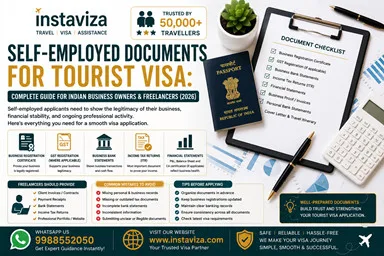
If you’re a business owner, freelancer, consultant, or self-employed professional, your tourist visa application requires a different set of supporting documents compared to salaried employees.
Unlike employees who submit salary slips and employment letters, self-employed applicants usually need to demonstrate the legitimacy of their business, financial stability, and ongoing professional activity.
In this guide, we’ll explain the documents commonly required, why they matter, and how to prepare them for a stronger tourist visa application.
Why Do Self-Employed Applicants Need Additional Documents?
Visa officers need to understand:
- How you earn your income
- Whether your business is genuine
- Whether you have sufficient funds for your trip
- Whether you have strong ties to India
Your documents should clearly demonstrate your financial position and your intention to return after your holiday.
Common Documents Required
The exact requirements vary by destination, but self-employed applicants are commonly asked to provide several of the following documents.
1. Business Registration Certificate
A business registration certificate helps establish that your business is legally registered.
Depending on your business structure, this could include:
- Proprietorship registration (where applicable)
- Partnership registration
- LLP registration
- Private Limited Company incorporation documents
2. GST Registration (Where Applicable)
If your business is registered under GST, the GST registration certificate may support your business profile.
Not every applicant will have or require GST registration.
3. Business Bank Statements
Business bank statements help demonstrate:
- Business transactions
- Cash flow
- Financial activity
- Business continuity
Many visa authorities also request personal bank statements in addition to business accounts.
4. Income Tax Returns (ITR)
Income Tax Returns are among the most valuable financial documents for self-employed applicants.
Many destinations commonly request recent assessment years, where applicable.
5. Financial Statements
Some applicants may also submit:
- Profit & Loss Statement
- Balance Sheet
- Chartered Accountant certification (where applicable)
These documents help explain the financial health of the business.
6. Business Proof
Depending on your profession, supporting documents may include:
- Company profile
- Business website
- Client invoices
- Business licences
- Professional memberships
These documents can further establish ongoing business activity.
What If You’re a Freelancer?
Freelancers generally do not have salary slips or employment letters.
Instead, they may provide:
- Client invoices
- Contracts
- Payment receipts
- Bank statements
- Income Tax Returns
- Professional portfolio or website
The exact requirements depend on the destination country and your individual circumstances.
Common Mistakes to Avoid
Avoid these common errors:
Mixing Personal and Business Records
Clearly organize your business and personal financial documents.
Missing Tax Documents
Submit the requested Income Tax Returns where applicable.
Incomplete Bank Statements
Ensure statements cover the requested period and include all pages.
Outdated Business Documents
Use the most recent registration certificates and financial records available.
Inconsistent Information
Business income, tax records, and bank statements should be consistent across your application.
Tips Before Applying
- Organize your financial records well in advance.
- Keep business registration documents updated.
- Maintain clear business banking records.
- Ensure consistency across all supporting documents.
- Review the latest official visa requirements for your destination.
Well-prepared documentation makes the application easier to assess.
Being self-employed does not prevent you from obtaining a tourist visa.
The key is providing clear, complete, and consistent documentation that demonstrates your business activity, financial stability, and intention to return to India after your trip.
Since every country has different documentation requirements, always review the latest official checklist before applying.
Frequently Asked Questions
Yes. Self-employed individuals regularly obtain tourist visas by submitting appropriate business and financial documents.
No. Self-employed applicants generally provide business-related financial documents instead.
Not necessarily. It depends on your business and the country’s document requirements.
Many visa applications request personal bank statements, and some may also require business bank statements depending on your circumstances.
Many freelancers successfully apply using alternative proof of professional activity, such as invoices, contracts, bank statements, and tax records, depending on the destination’s requirements.
Are you self-employed or a business owner planning an international holiday?
Instaviza assists entrepreneurs, freelancers, consultants, and business owners with document verification, financial guidance, and tourist visa applications for 40+ countries.
✅ Trusted by 50,000+ Travellers
📱 WhatsApp: 9988552050
🌐 Website: www.instaviza.com

Author: Visa & Travel Desk – Instaviza
The Visa & Travel Desk at Instaviza is a team of experienced visa documentation specialists and travel consultants who track global immigration policies, embassy announcements, airline advisories, and international travel regulations affecting Indian travellers. With years of experience assisting Indian passport holders with tourist visas, passport services, and travel insurance, Instaviza is committed to publishing accurate, reliable, and up-to-date travel information. Content published under Instaviza’s Editorial Policy.