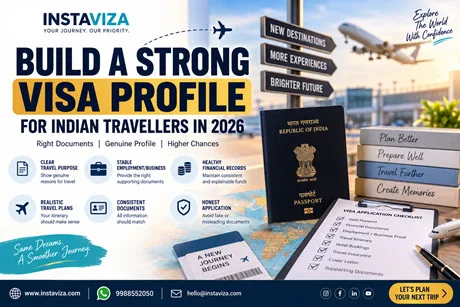
Getting a tourist visa is not simply about submitting a large number of documents.
A strong application is about presenting a clear, genuine and consistent picture of your trip and circumstances.
For Indian travellers, this can mean demonstrating that:
- You have a genuine reason to travel.
- You can financially support the trip.
- Your employment or business situation is credible.
- Your proposed itinerary makes sense.
- Your documents are consistent.
- You have reasonable reasons to return to India.
There is no formula that can guarantee visa approval. Every application is assessed according to the destination country’s rules and the individual applicant’s circumstances.
However, you can significantly improve the quality and credibility of your application by preparing it properly.
What Is a Visa Profile?
Your visa profile is essentially the overall picture created by your application.
It can include:
- Your employment or business
- Income
- Bank balance and financial history
- Tax records
- Previous travel
- Family circumstances
- Purpose of travel
- Travel itinerary
- Accommodation
- Travel expenses
- Supporting documents
- Previous visa history
Visa officers don’t necessarily look at one document in isolation.
They may consider whether the information across your application makes sense together.
For example, if someone declares a modest monthly income but suddenly shows a very large unexplained deposit immediately before applying, that could raise questions.
The goal should therefore be consistency and transparency, not simply adding more documents.
1. Have a Clear Purpose of Travel
The first step is to clearly establish why you’re travelling.
For a tourist visa, your purpose should genuinely be tourism.
Your itinerary should broadly explain:
- Where you are going
- How long you intend to stay
- Which cities you plan to visit
- Where you intend to stay
- What you plan to do
Your plans should be realistic.
For example, a 7-day holiday covering 6 countries may appear less credible than a well-planned 7-day trip covering one or two destinations.
2. Show Stable Employment or Business
Your professional situation can be an important part of your overall profile.
If you are salaried
Depending on the destination, supporting documents may include:
- Employment letter
- Salary slips
- Bank statements showing salary credits
- Leave approval
- Income-tax documents where applicable
The information should be consistent.
Your salary mentioned in your application should broadly correspond with your financial records.
If you are self-employed
You may provide relevant documents such as:
- Business registration
- GST documents, where applicable
- Business bank statements
- Personal bank statements
- Income-tax returns
- Company or business ownership evidence
Don’t submit every document you have simply to make the application look bigger.
Submit documents that genuinely support your circumstances and are relevant to the visa requirements.
3. Maintain Healthy Financial Records
Financial capacity is one of the areas many applicants worry about.
But there is no universal bank balance required for every tourist visa.
The appropriate amount depends on:
- Destination
- Trip duration
- Accommodation
- Flights
- Number of travellers
- Your income
- Your normal financial activity
A strong financial profile is not necessarily the person with the biggest bank balance.
It is often the person whose finances are genuine, explainable and consistent with their income and proposed trip.
4. Avoid Unexplained Large Deposits
This is one of the most important points.
Suppose your normal bank balance is ₹1–2 lakh and suddenly ₹10 lakh appears shortly before your visa application.
If the source isn’t clear, it may raise questions.
If you genuinely received money from:
- Sale of property
- Maturity of an investment
- Business transaction
- Family support
- Fixed deposit
- Other legitimate sources
then appropriate evidence or an explanation may be necessary depending on the visa requirements.
Don’t artificially inflate your bank balance before applying.
A genuine financial history is much more useful than a temporary balance created just for the application.
5. Keep Your Bank Statements Consistent
Your bank statement should tell a believable financial story.
For example:
Salary → regular expenses → savings → planned travel
is generally easier to understand than:
Low regular activity → sudden large deposit → immediate visa application
Your financial documents should ideally support the income and circumstances you have declared.
6. Show Your Travel Plans Clearly
A good itinerary doesn’t need to be complicated.
For example:
Day 1–2
Arrive in Paris and explore central Paris.
Day 3
Visit major attractions.
Day 4
Day trip or additional sightseeing.
Day 5
Continue sightseeing and shopping.
Day 6
Return to India.
The exact itinerary will depend on your destination.
The important thing is that your accommodation, flights and sightseeing plans should broadly fit together.
7. Hotel Bookings Should Match Your Itinerary
Your accommodation should make sense based on your travel plans.
If your itinerary says:
Paris → Rome → Venice
your hotel bookings should broadly correspond with those locations and dates.
Avoid creating unnecessarily complicated hotel arrangements.
For a visa application, the objective is to demonstrate a credible travel plan, not to submit dozens of reservations.
8. Make Your Employment Leave Evidence Clear
If you’re employed, approved leave can help demonstrate that your employer expects you to return to work.
A leave letter may include:
- Your name
- Position
- Employment details
- Approved leave dates
- Expected date of resumption
- Employer’s contact information
Requirements vary by country, so always follow the specific visa checklist.
9. Previous Travel History Can Help — But It Isn’t Everything
A history of international travel can sometimes strengthen an application because it demonstrates previous compliance with immigration rules.
However:
No travel history does not automatically mean visa refusal.
Many people successfully obtain their first international visa without having travelled abroad previously.
If you are a first-time traveller, focus on making the rest of your application clear and genuine.
10. Build a Consistent Application
This is one of the most important principles.
Your:
Visa form + bank statement + salary slips + employment letter + itinerary + hotel booking + travel dates
should not contradict each other.
For example, if your application says you earn ₹80,000 per month but your submitted financial documents show something significantly different, you may need to explain the discrepancy.
Similarly, if your stated travel dates don’t match your hotel booking or leave approval, it can create unnecessary confusion.
11. Explain Unusual Circumstances
Not every applicant has a standard profile.
You may be:
- Recently employed
- Recently self-employed
- Between jobs
- A business owner
- Retired
- A homemaker
- Financially sponsored by a family member
- Travelling with your spouse
- Travelling with parents or children
An unusual profile is not automatically a weak profile.
The key is to document and explain the circumstances honestly.
12. Don’t Submit Fake Documents
Never create or alter documents to improve a visa application.
This includes:
- Fake bank statements
- Fake employment letters
- Fake salary slips
- Fake hotel bookings
- Fake flight documents
- Altered tax documents
- Misleading information
Providing false information can have consequences far more serious than a simple visa refusal.
If a document is unavailable, look for a legitimate alternative or explanation rather than manufacturing one.
13. Don’t Overload the Application With Irrelevant Documents
More documents don’t automatically mean a stronger application.
A visa officer should be able to understand your application without searching through dozens of irrelevant papers.
Organise your documents logically.
For example:
Personal
Passport and photographs
Employment
Employment letter, salary slips and leave approval
Financial
Bank statements, ITR and other relevant financial documents
Travel
Flights, hotels and itinerary
Additional
Other documents specifically required by the destination
A clean application is easier to understand.
14. Your Cover Letter Should Connect the Application
A good cover letter can explain the purpose of your trip and provide context.
It can mention:
- Why you’re travelling
- Travel dates
- Destinations
- Who is travelling
- Who is paying
- Your employment/business
- Any important circumstances
It should not be an exaggerated sales pitch.
The purpose is to clarify your application, not make unrealistic promises.
15. Don’t Try to Manufacture a “Perfect” Profile
One of the biggest misconceptions about visas is that there is a perfect profile.
There isn’t.
A young first-time traveller may have a completely legitimate application.
A self-employed person may have a legitimate application.
A homemaker travelling with a spouse may have a legitimate application.
A retired applicant may have a legitimate application.
The objective isn’t to make your profile look like somebody else’s.
The objective is to accurately document your own circumstances.
What Makes a Strong Tourist Visa Profile?
A strong application generally has these characteristics:
✔ Genuine purpose
The reason for travel is clear.
✔ Financial consistency
The finances support the proposed trip and are explainable.
✔ Stable circumstances
Employment, business or other personal circumstances are properly documented.
✔ Realistic itinerary
The trip makes sense for the available time and budget.
✔ Consistent documents
Information matches across different documents.
✔ Honest information
Nothing is fabricated or misleading.
✔ Proper documentation
The application follows the destination’s requirements.
What Can Weaken a Visa Profile?
Common warning signs can include:
- Unexplained large deposits
- Contradictory information
- Unrealistic itineraries
- Insufficient financial evidence
- Missing required documents
- Unclear source of funds
- False information
- Fake documents
- Weak explanation for unusual circumstances
- Travel plans that don’t match employment leave
- Incorrect or inconsistent dates
Not every issue automatically results in refusal, but avoiding preventable inconsistencies is important.
Can a Travel Agent Guarantee Visa Approval?
No.
No genuine travel agency or visa consultant can guarantee that an embassy or immigration authority will approve a visa.
The final decision belongs to the relevant government authority.
A professional visa assistance service can help you:
- Understand requirements
- Prepare documents
- Identify inconsistencies
- Organise the application
- Complete forms
- Prepare supporting information
But visa approval cannot be guaranteed.
Be cautious of anyone promising guaranteed approval in exchange for money.
Final Checklist Before Submitting Your Visa Application
Before submitting your application, ask yourself:
☐ Is my travel purpose genuine?
☐ Are my travel dates consistent everywhere?
☐ Does my itinerary make sense?
☐ Do my hotel arrangements match my itinerary?
☐ Can I demonstrate sufficient funds for the planned trip?
☐ Is the source of my funds explainable?
☐ Are my employment/business documents genuine?
☐ Do my bank statements support my declared income?
☐ Have I provided all mandatory documents?
☐ Have I explained anything unusual in my profile?
☐ Is all information truthful?
☐ Have I avoided unnecessary documents?
If the answer to these questions is yes, you’ve taken important steps toward presenting a clear and credible tourist visa application.
Building a strong visa profile isn’t about having the highest bank balance, the longest passport history or the biggest stack of documents.
It’s about credibility, consistency and genuine documentation.
Your financial situation should make sense.
Your travel plans should make sense.
Your employment or business situation should be properly documented.
And everything you submit should tell the same story.
There is no guaranteed formula for visa approval, but a carefully prepared application can help you avoid many common and preventable problems.
If you’re unsure about the requirements for a particular destination, check the official immigration or embassy guidance before submitting your application.
Frequently Asked Questions
A strong visa profile is a genuine and well-documented application where the applicant’s travel purpose, finances, employment or business circumstances and supporting documents are consistent.
No. A high bank balance alone does not guarantee approval. Visa decisions can consider the applicant’s overall circumstances and the requirements of the destination country.
Yes, depending on the destination and your overall circumstances. Previous international travel is not universally mandatory.
Focus on genuine financial records, consistent documentation, a realistic itinerary, proper employment or business evidence and truthful information.
You should not artificially increase your balance simply for a visa application. Genuine deposits should have a legitimate and explainable source.
ITR can be relevant for demonstrating financial and income circumstances, depending on the destination and applicant’s profile. Always follow the specific country’s document requirements.
Yes. Self-employed applicants can apply for tourist visas. They may need to provide appropriate business, financial and tax documents depending on the destination.
No. A cover letter can help explain an application, but it cannot guarantee approval.
No legitimate consultant can guarantee a government visa decision. The final decision rests with the relevant immigration or consular authority.
There is no single document that guarantees approval. A genuine purpose of travel, consistent information and appropriate supporting documentation are all important.

Author: Visa & Travel Desk – Instaviza
The Visa & Travel Desk at Instaviza is a team of experienced visa documentation specialists and travel consultants who track global immigration policies, embassy announcements, airline advisories, and international travel regulations affecting Indian travellers. With years of experience assisting Indian passport holders with tourist visas, passport services, and travel insurance, Instaviza is committed to publishing accurate, reliable, and up-to-date travel information. Content published under Instaviza’s Editorial Policy.