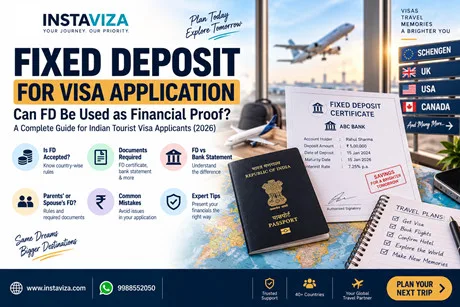
If you have money in fixed deposits (FDs) rather than keeping all your savings in a regular bank account, you may wonder:
Can I show my fixed deposit for a tourist visa?
In many situations, an FD can be a useful supporting financial document because it demonstrates that you have accumulated savings.
However, an FD should not automatically be treated as a replacement for your bank statement.
The important question is not simply how much money you have in an FD.
It is also:
Can the funds be accessed when needed? Where did the money come from? Does it make sense with your overall financial profile?
Visa requirements vary by destination, so applicants should always check the current requirements for their particular country.
What Is a Fixed Deposit?
A fixed deposit is a financial product in which you place a specific amount of money with a bank for a defined period, usually at an agreed rate of interest.
Unlike an ordinary savings account, an FD is normally intended to remain invested for a particular tenure.
For a visa application, your FD can demonstrate that you have genuine accumulated savings.
Can a Fixed Deposit Be Used for a Tourist Visa?
It can be useful as supporting financial evidence, depending on the destination and its requirements.
For example, the European Commission’s Schengen supporting-document materials have included fixed-term deposits among forms of financial evidence in certain country-specific checklists. However, individual Schengen countries and their consulates can have their own requirements.
The UK takes a different approach. Its visitor guidance focuses on whether applicants have sufficient funds available and asks for financial evidence showing access to funds and the origin of those funds.
So the answer is not:
“FD is always accepted.”
Nor is it:
“FD is never accepted.”
The correct answer is:
Check the specific visa requirements for your destination.
Why Can an FD Strengthen Your Financial Profile?
A long-standing FD can help demonstrate accumulated savings.
For example, suppose you have:
Savings account: ₹2 lakh
Fixed deposits: ₹5 lakh
Together, these may provide a more complete picture of your savings than the savings account alone.
An FD can be particularly useful when it is:
- In your name
- Genuine
- Supported by bank documentation
- Consistent with your financial history
- Clearly identifiable
Should You Submit the FD Certificate?
Where the destination accepts or permits such evidence, you can provide the relevant bank-issued FD documentation.
Depending on the bank and visa requirements, this could include:
- FD certificate
- FD advice
- Bank statement showing the FD
- Bank letter
- Other official proof of deposit
Make sure the document clearly establishes:
- Your name
- Bank name
- Deposit amount
- Deposit date
- Maturity date
- Deposit number or reference
- Other relevant details
The exact format depends on your bank.
Is an FD Better Than a Bank Statement?
They serve different purposes.
Bank Statement
Shows:
- Income credits
- Expenses
- Transfers
- Savings
- Account activity
- Transaction history
Fixed Deposit
Shows:
- Amount invested
- Date of investment
- Maturity information
- Accumulated savings
An FD can demonstrate savings, but a bank statement can provide much more context about your day-to-day finances.
For this reason, an applicant should not automatically assume that an FD replaces a bank statement.
Should You Show Both FD and Bank Statement?
Where relevant and accepted, showing both can provide a clearer financial picture.
For example:
Bank statement: Shows your regular salary and savings.
FD certificate: Shows additional accumulated savings.
Together, these can help explain your overall financial position.
However, always follow the specific document checklist.
What If the FD Is Recently Created?
This is where you should be careful.
Creating a new FD immediately before applying isn’t automatically a problem.
You may have legitimately transferred money from your savings account into an FD.
For example:
Savings account → ₹5 lakh → FD created
If the transaction is genuine, the bank records can help explain what happened.
The concern arises when an applicant suddenly receives a large unexplained amount and converts it into an FD just before applying.
The source of the money should be genuine and explainable.
UK visitor guidance specifically says financial evidence should show the origin of funds and notes that decision makers may make further checks where most or all of the funds have not been held for long.
Can You Create an FD Just Before a Visa Application?
Yes, you can create a legitimate FD whenever you want.
But don’t create one using borrowed or unexplained funds simply to improve your visa application.
For example, if you transfer ₹5 lakh from your own savings into an FD, the transaction can generally be traced through your banking history.
That’s very different from receiving ₹5 lakh from an unknown source immediately before applying.
The important thing is the genuine source of funds.
What If the FD Is in Your Parents’ Name?
This is different from an FD in your own name.
If you’re using your parents’ FD to support your application, the financial arrangement may need to be explained.
Depending on the destination, you may need:
- Sponsor letter
- Parent’s FD certificate
- Parent’s bank statements
- Parent’s ITR
- Relationship proof
- Other sponsor documents
The exact requirements depend on the destination.
What If the FD Is in Your Spouse’s Name?
The same principle applies.
If your spouse owns the FD and is funding your holiday, your application should clearly explain the financial arrangement.
Supporting documents can include, where relevant:
- Spouse’s FD certificate
- Bank statements
- Income proof
- ITR
- Marriage certificate
- Sponsorship letter
Don’t simply attach your spouse’s FD without explaining whose money it is and how it relates to your travel expenses.
Can Senior Citizens Use Fixed Deposits for a Tourist Visa?
Yes, an FD can be particularly relevant for retirees because some retirees have substantial savings in FDs but no regular salary.
A retired applicant may have:
- Pension
- Savings
- Fixed deposits
- Investments
- Bank statements
- ITR, where applicable
The application should clearly explain how the trip will be funded.
Can Self-Employed Applicants Use Fixed Deposits?
Yes, where accepted by the destination.
For a business owner or self-employed professional, an FD can demonstrate accumulated personal savings.
It should ideally be considered alongside other financial evidence such as:
- ITR
- Personal bank statements
- Business bank statements
- Business registration
- GST documents, where applicable
- Financial statements
Does an FD Prove Your Income?
No.
This is important.
An FD demonstrates that you have deposited money with a bank.
It does not automatically tell the visa officer:
- How you earn your monthly income
- Your business revenue
- Your salary
- Your tax history
That’s why documents such as ITR, salary slips and bank statements can still be important.
Does an FD Prove You Have Available Funds?
It depends on the FD terms and destination requirements.
A deposit that can be withdrawn or liquidated may be more relevant to available funds than money that is genuinely inaccessible.
For the UK, financial evidence must clearly demonstrate access to funds, and the relevant financial rules distinguish funds that can be accessed immediately from instruments where the funds cannot be withdrawn immediately.
For other destinations, the rules may be different.
What If Your FD Has a Long Maturity Period?
Don’t automatically assume that the entire FD amount should be treated as immediately available travel money.
An FD with a long remaining tenure may require premature withdrawal or may have restrictions.
Your application should accurately represent whether and how the money can be accessed.
FD vs Savings Account
A simple comparison:
| Savings Account | Fixed Deposit |
|---|---|
| Money usually available immediately | Money invested for a fixed tenure |
| Shows regular transactions | Shows accumulated savings |
| Shows income and expenses | Shows deposit amount and maturity |
| Useful for current financial activity | Useful as supporting savings evidence |
For many applicants, having both can provide a better understanding of their finances.
FD vs Mutual Funds and Investments
An FD is also different from other investments.
Mutual funds, shares and other investments can fluctuate in value and may not be treated the same way as readily available cash.
A visa authority may have specific rules regarding acceptable financial evidence.
Don’t assume that every investment automatically qualifies as immediately available travel funds.
Can You Use an FD for a Schengen Visa?
Potentially, depending on the specific country’s requirements.
Schengen applications require evidence of sufficient financial means, and the EU Visa Code requires applicants to demonstrate sufficient means for the stay and return. Member States can set their own reference amounts.
Some official Schengen supporting-document materials have listed fixed-term deposits among possible financial evidence.
However, don’t assume that one Schengen country’s checklist automatically applies to every other Schengen country.
Always use the current checklist for the country handling your application.
Can You Use an FD for a UK Tourist Visa?
The UK focuses on whether visitors have sufficient funds and can access those funds.
Current UK visitor guidance recommends financial documents that show access to funds and the origin of the money, including bank statements and proof of earnings.
Therefore, an Indian applicant shouldn’t assume that simply attaching an FD certificate is sufficient.
The accessibility of the money and the overall financial picture are important.
Can You Use an FD for a USA Tourist Visa?
There is no universal FD-specific rule that applies to every US visitor visa applicant.
The US Department of State states that applicants may be asked for evidence demonstrating the purpose of the trip, intent to depart and ability to pay the costs of the trip.
An FD may therefore form part of your overall financial picture where appropriate, but it shouldn’t be treated as a guarantee or universal substitute for other financial evidence.
Should You Break Your FD Before Applying?
Usually, don’t break an FD simply because you believe the money needs to appear in your savings account.
If the FD itself is acceptable financial evidence for the destination, keeping the deposit in place may be perfectly reasonable.
If the destination specifically requires readily accessible funds, then the treatment of the FD may be different.
The correct approach depends on the applicable rules.
What If Your FD Has Just Matured?
If your FD recently matured and the money was transferred into your savings account, your bank statements may show the transaction.
Keep the relevant FD maturity record if an explanation is needed.
This can help establish where the money came from.
Common Mistakes When Showing an FD
1. Treating the FD as Your Income
An FD represents savings, not necessarily current income.
2. Showing Only the FD
Some destinations may require other financial records as well.
3. Using Someone Else’s FD Without Explanation
Clearly establish the sponsor and financial relationship where applicable.
4. Creating an FD With Borrowed Funds
Don’t manufacture a financial profile for a visa application.
5. Ignoring Accessibility
An FD that cannot be accessed immediately may not be treated the same way as readily available funds.
6. Providing Unclear Bank Documents
Use official and readable documents.
How to Prepare Your FD for a Visa Application
Before submitting your application:
1. Check the official visa checklist.
Find out whether fixed deposits are accepted as financial evidence.
2. Obtain official FD documentation.
Use a bank-issued certificate or other accepted record.
3. Show the source of funds where relevant.
If the deposit was recently created or funded through a large transfer, maintain supporting records.
4. Include your bank statement where required.
This can help connect the FD with your broader financial history.
5. Be consistent.
The amount and ownership of the FD should match your other documents.
A fixed deposit can be valuable supporting financial evidence for a tourist visa, particularly when it represents genuine savings accumulated over time.
But an FD shouldn’t automatically be treated as a substitute for your bank statement, income proof or ITR.
The most important questions are:
Is the money genuinely yours?
Can the source of funds be explained?
Is the money accessible where required?
Does the FD fit your overall financial profile?
Does the destination accept it as financial evidence?
There is no universal answer for every tourist visa.
Check the current requirements for your destination before applying and submit genuine, relevant and consistent financial documents.
If you need help preparing your tourist visa documentation, Instaviza assists Indian travellers with tourist visa applications for 40+ countries.
WhatsApp: 9988552050
Website: www.instaviza.com
Frequently Asked Questions
A fixed deposit can be useful as supporting financial evidence where the destination accepts it and the funds are relevant to the financial requirement.
Not necessarily. You may still need bank statements, income proof, ITR or other financial documents depending on the destination.
You can create a genuine FD, but the funds should come from a legitimate and explainable source. Avoid creating artificial financial balances for visa purposes.
Not automatically. Whether an FD needs to be liquidated depends on the destination’s requirements and how it treats accessible funds.
Not automatically. An FD demonstrates a deposit, while a bank statement shows transaction history and account activity.
It may be possible where sponsorship is accepted. You may need sponsor and relationship documents in addition to the FD evidence.
Potentially, if your spouse is financially supporting the trip and the destination permits that arrangement. Supporting sponsorship and relationship documents may be required.
No. An FD generally demonstrates savings rather than regular income.
Yes, where accepted. It can supplement ITR, bank statements and business documents.
An FD can be relevant to a retiree’s financial profile, alongside pension, bank statements and other applicable financial evidence.
It may be accepted in some circumstances, but requirements can differ between Schengen countries. Follow the checklist for the country handling your application.
Instaviza provides tourist visa assistance and documentation guidance for Indian travellers applying to 40+ countries.

Author: Visa & Travel Desk – Instaviza
The Visa & Travel Desk at Instaviza is a team of experienced visa documentation specialists and travel consultants who track global immigration policies, embassy announcements, airline advisories, and international travel regulations affecting Indian travellers. With years of experience assisting Indian passport holders with tourist visas, passport services, and travel insurance, Instaviza is committed to publishing accurate, reliable, and up-to-date travel information. Content published under Instaviza’s Editorial Policy.