When preparing a tourist visa application, your bank statement can be one of the most important financial documents.
But many Indian travellers have questions:
How many months of bank statements should I provide?
How much balance should I maintain?
Is a savings account enough?
What happens if there is a large deposit?
Can I submit my business account?
The answer isn’t the same for every country.
Different visa authorities have different requirements, and financial assessment can also depend on your employment, income, travel plans and who is paying for the trip.
In this guide, we’ll explain how bank statements are generally used in tourist visa applications and what you should check before submitting yours.
What Is a Bank Statement for a Tourist Visa?
A bank statement is an official record of transactions and balances in your bank account over a particular period.
It can show:
- Opening balance
- Deposits
- Withdrawals
- Salary credits
- Business transactions
- Transfers
- Closing balance
- Account holder details
For a tourist visa application, it can help demonstrate your current financial position and normal financial activity.
Why Do Visa Authorities Ask for Bank Statements?
A bank statement can help establish several aspects of your financial situation.
1. Can You Afford the Trip?
Your available funds should be reasonably consistent with your proposed travel expenses.
2. Where Does Your Money Come From?
Regular salary or business credits can help explain your financial activity.
3. Is Your Financial Activity Genuine?
A transaction history can provide more context than simply showing a balance certificate.
4. Is the Trip Realistic?
Your accommodation, flights and other expenses should make sense in relation to your finances.
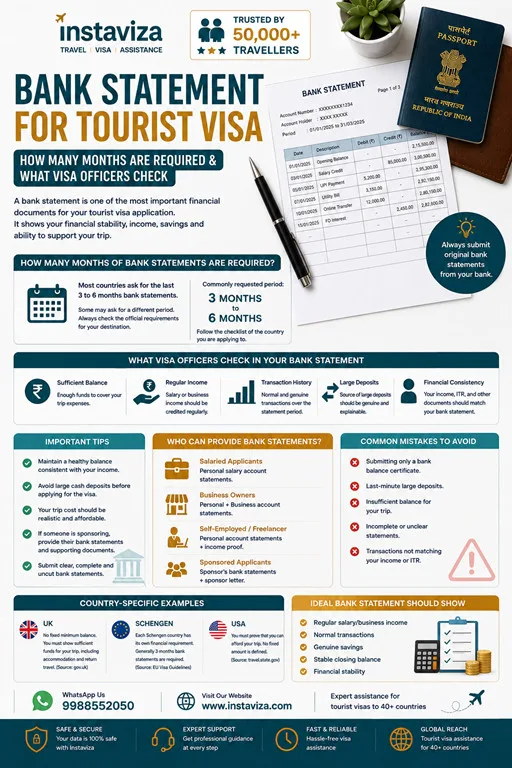
How Many Months of Bank Statements Are Required?
There is no universal number of months for every tourist visa.
The requirement can vary by:
- Country
- Visa category
- Applicant’s circumstances
- Employment status
- Type of application
Some destinations may request several months of statements.
For example, EU guidance for Schengen applications refers to recent bank statements showing movements over a certain period, with the guidance referencing at least the last three months. However, applicants should always follow the specific requirements of the country handling their application.
The UK also assesses whether applicants have sufficient funds for their proposed visit rather than prescribing one universal bank-balance figure for every visitor.
Always check the current requirements for your destination before submitting documents.
Should You Submit More Months Than Required?
Not necessarily.
If a visa checklist requests a particular period, follow it.
Providing additional statements isn’t automatically better.
The goal should be:
Relevant + complete + genuine + easy to understand.
If your financial history requires additional explanation, relevant supporting documents may be more useful than simply adding large amounts of paperwork.
What Does a Visa Officer Look at in a Bank Statement?
A bank statement isn’t just about the final balance.
The transaction history can also be important.
A visa officer may look at:
Regular Income
Are salary or business payments appearing regularly?
Normal Expenses
Does the account show ordinary financial activity?
Closing Balance
Are sufficient funds available for the proposed trip?
Large Deposits
Are significant credits genuine and explainable?
Account Activity
Does the account appear to be actively used?
Consistency
Does the bank statement make sense alongside your ITR, salary slips and other documents?
Is a High Bank Balance Enough?
No.
This is one of the biggest misconceptions about tourist visas.
A high balance does not automatically guarantee approval.
For example, an applicant may show a large balance but have:
- No clear source of funds
- Very low regular income
- Large unexplained recent deposits
- A trip that appears disproportionate to their financial circumstances
Another applicant may have a lower balance but a long-standing, stable financial history and a reasonably priced trip.
The complete financial picture matters.
What About Large Deposits?
A large deposit isn’t automatically a problem.
What matters is whether it is genuine and explainable.
Legitimate examples could include:
- Property sale proceeds
- Fixed deposit maturity
- Investment redemption
- Business payment
- Salary arrears
- Transfer from another personal account
- Family financial support
If necessary, supporting documentation can help explain the source.
For example, if a large amount came from a property sale, relevant sale documentation and bank records may help establish its source.
Should You Deposit Money Before Applying?
You should never artificially inflate your bank balance simply to make your visa application appear stronger.
A sudden large deposit immediately before applying can raise questions if its source isn’t clear.
Instead, maintain and submit your genuine financial history.
If you have legitimately received a large amount of money, keep appropriate evidence explaining where it came from.
What If Your Salary Is Credited Every Month?
This is generally straightforward to explain.
For salaried applicants, the bank statement may show:
Employer → Regular salary credit → Normal household expenses → Remaining savings
This can create a clear connection between your employment documents and bank activity.
Your salary slips and bank statement should be reasonably consistent.
What If Your Salary Is Paid in Cash?
Cash-based income can make financial documentation more complicated.
If your employment arrangement genuinely involves cash payments, you should follow the visa authority’s requirements and provide legitimate alternative evidence of income and employment.
Never create artificial bank credits to make cash income appear like salary.
Can I Submit a Savings Account Statement?
Yes, if the destination’s requirements accept it and the account genuinely belongs to you.
A savings account can demonstrate:
- Savings
- Regular transactions
- Available funds
However, the exact account type and financial documentation requirements depend on the destination.
Can I Submit a Current Account Statement?
Business owners and companies may use current accounts for business transactions.
For a business owner, a business current account statement can help demonstrate business activity.
However, it may not automatically replace a personal account statement if the visa checklist asks for personal financial information.
In some cases, both can be relevant.
Bank Statement for Business Owners
Business owners often have more complicated financial profiles.
Their financial documentation may include:
- Personal bank statements
- Business bank statements
- ITR
- Business registration
- GST registration, where applicable
- P&L statement
- Balance Sheet
- Invoices
The key is to clearly distinguish between:
Business money and personal travel funds.
If your holiday is being paid from personal savings, demonstrate that appropriately.
If your business is funding a legitimate business-related trip, the documentation may be different from a normal personal tourist holiday.
Bank Statement for Self-Employed Applicants
Self-employed applicants may not have monthly salary credits.
Their bank statements may instead show:
- Client payments
- Professional income
- Business transfers
- Other legitimate receipts
Supporting documents such as ITR, invoices, contracts or business records may help explain these transactions where relevant.
What If You Have Multiple Bank Accounts?
Many people maintain more than one account.
For example:
- Salary account
- Savings account
- Business account
- Investment account
If multiple accounts are relevant to your financial position, follow the destination’s requirements and present them clearly.
Don’t submit numerous accounts simply to make the application look financially stronger.
Can I Submit My Spouse’s Bank Statement?
If your spouse is financially supporting your trip, their financial documents may be relevant.
However, don’t simply submit your spouse’s bank statement without explaining the relationship and sponsorship arrangement.
Depending on the destination, you may need:
- Sponsor letter
- Marriage certificate
- Spouse’s bank statements
- Spouse’s income proof
- ITR
- Other supporting documents
What If My Parents Are Paying for My Trip?
This is common for students and young travellers.
The application may include the parent’s:
- Bank statements
- ITR
- Salary slips
- Employment letter
- Sponsor letter
- Relationship proof
The exact documents depend on the destination.
What If My Bank Balance Is Low?
A low balance doesn’t automatically mean a visa will be refused.
The important question is whether your overall finances reasonably support your proposed trip.
For example, you may have:
- Current salary
- Regular savings
- Sponsor support
- Other legitimate financial resources
Your travel plans should also be realistic.
A short, modest holiday may have very different financial requirements from an expensive month-long vacation.
What If My Bank Balance Is High but My Income Is Low?
This can happen for legitimate reasons.
You may have:
- Long-term savings
- Investment proceeds
- Property sale proceeds
- Family support
- Other legitimate funds
If there is a significant difference between your income and available funds, make sure you can explain the source where appropriate.
Bank Statement vs Bank Balance Certificate
These documents are different.
Bank Statement
Shows:
- Transactions
- Credits
- Debits
- Balances
- Account activity
Bank Balance Certificate
Usually confirms the balance in the account at a particular point in time.
A balance certificate alone may not provide the transaction history that a visa authority wants.
Always submit what the official checklist requests.
Should You Highlight Transactions?
Usually, avoid manually altering official statements.
If a transaction needs explanation, provide a separate explanation or supporting document where appropriate.
Your bank statement itself should remain an authentic bank-issued record.
Should You Get the Bank Statement Stamped?
Requirements vary.
Some applications may ask for bank statements in a particular format or certification, while others accept electronically generated official statements.
Don’t assume that every visa application requires a bank stamp.
Follow the specific checklist.
What Makes a Bank Statement Look Suspicious?
There is no single “suspicious statement” formula.
However, applicants should be careful about:
- Large unexplained deposits
- Unusual transfers immediately before applying
- Financial information inconsistent with income
- Statements that don’t cover the required period
- Missing pages or transactions
- Unexplained third-party transfers
If a transaction is legitimate, keep the relevant supporting evidence.
Should Your Bank Balance Be the Same Every Month?
No.
Normal bank accounts naturally fluctuate.
You may receive your salary and then pay:
- Rent
- EMI
- Household expenses
- School fees
- Bills
- Investments
A natural financial pattern is not a problem simply because the balance changes.
How to Prepare Your Bank Statement Before Applying
Step 1: Check the Official Requirement
Confirm the required statement period.
Step 2: Download Official Statements
Use statements issued by your bank.
Step 3: Review Transactions
Look for unusual transactions that may require supporting documents.
Step 4: Match Your Income
Compare your bank credits with your salary, ITR or business income.
Step 5: Calculate Your Trip Cost
Estimate:
- Flights
- Hotels
- Food
- Transportation
- Activities
- Insurance
- Other expenses
Step 6: Explain Sponsorship
If someone else is paying, provide appropriate sponsor documentation.
Step 7: Keep Everything Genuine
Never edit or manipulate bank statements.
A Simple Example
Suppose an applicant has:
Monthly salary: ₹1,50,000
Savings: ₹7,00,000
Trip duration: 8 days
Estimated trip cost: ₹2,50,000
The applicant’s financial position may appear reasonably understandable if the savings were accumulated legitimately and the documents support the income.
Now consider an applicant with:
Monthly income: ₹40,000
Normal savings: ₹60,000
Sudden deposit: ₹8,00,000
Trip cost: ₹6,00,000
The second situation doesn’t automatically mean refusal, but the source and purpose of the large deposit may need to be explained.
The lesson is simple:
Don’t focus only on the final bank balance.
A bank statement for a tourist visa is much more than a document showing how much money you have.
It can help demonstrate your:
Financial activity + income + savings + source of funds + ability to fund the trip.
There is no universal rule requiring every traveller to maintain a specific balance or provide exactly the same number of months of statements.
Your destination’s requirements should always be the starting point.
Most importantly, submit genuine, complete and consistent financial records.
If you need help preparing your tourist visa documentation, Instaviza assists Indian travellers with tourist visa applications for 40+ countries.
WhatsApp: 9988552050
Website: www.instaviza.com
Frequently Asked Questions
There is no universal period. Requirements vary by country and visa category. Always check the current checklist for your destination.
No. The source of funds, transaction history, income, trip cost and overall financial circumstances can also matter.
A legitimate large deposit isn’t automatically a problem. However, unexplained or artificial deposits can raise questions.
Don’t deposit money simply to artificially increase your balance. Your financial records should reflect your genuine circumstances.
A savings account can be used where accepted by the destination and relevant to your financial circumstances.
Business owners may submit business bank statements where relevant, but personal financial statements may also be required depending on the destination.
If your spouse is sponsoring your trip, their financial documents may be relevant along with appropriate sponsorship and relationship documentation.
Parents can financially support their children in many circumstances. The required sponsor documents depend on the destination.
A low balance doesn’t automatically mean refusal. Your income, savings, sponsorship and overall financial circumstances should reasonably support the proposed trip.
You may still need your own documents. The exact requirements depend on the destination and your circumstances.
No. A bank balance certificate generally confirms a balance, while a bank statement provides transaction history and account activity.
Instaviza provides tourist visa assistance and documentation guidance for Indian travellers applying to 40+ countries.

Author: Visa & Travel Desk – Instaviza
The Visa & Travel Desk at Instaviza is a team of experienced visa documentation specialists and travel consultants who track global immigration policies, embassy announcements, airline advisories, and international travel regulations affecting Indian travellers. With years of experience assisting Indian passport holders with tourist visas, passport services, and travel insurance, Instaviza is committed to publishing accurate, reliable, and up-to-date travel information. Content published under Instaviza’s Editorial Policy.