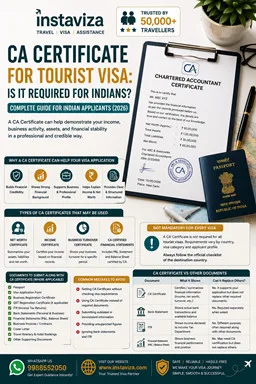
If you’re a business owner, entrepreneur, self-employed professional, freelancer, or high-net-worth traveller, you may have heard about submitting a CA Certificate with a tourist visa application.
A Chartered Accountant (CA) certificate can sometimes help explain your financial position, business income, assets, or net worth. However, it is important to understand that a CA certificate is not universally required for every tourist visa application.
Whether you need one depends on the destination country, visa category, your occupation, and the specific financial documents requested.
In this guide, we’ll explain what a CA certificate is, when it can be useful, what information it may contain, and how it differs from bank statements, ITRs, and financial statements.
What Is a CA Certificate for a Tourist Visa?
A CA certificate is a financial or business-related certificate prepared or certified by a Chartered Accountant based on the relevant financial records and information available.
Depending on the purpose, a CA may certify information such as:
- Income
- Net worth
- Business turnover
- Assets
- Liabilities
- Financial position
- Business financial statements
The exact format and contents depend on what is being certified and what the visa authority requires.
Is a CA Certificate Mandatory for a Tourist Visa?
No, not for every tourist visa.
There is no universal rule requiring every Indian tourist visa applicant to submit a CA certificate.
It may become relevant when:
- The applicant is self-employed.
- The applicant owns a business.
- The applicant needs to explain their financial position.
- The visa checklist specifically requests certified financial documents.
- A particular financial document needs professional certification.
The most important rule is to follow the destination-specific official checklist.
Do not obtain a CA certificate simply because another applicant used one.
Why Can a CA Certificate Help?
For business owners and self-employed applicants, financial documentation can sometimes be complicated.
A CA-certified document may help organize or explain financial information in a more formal manner.
It can potentially support:
Financial Credibility
It can provide additional context about the applicant’s financial position.
Business Profile
Business owners may use relevant certified financial information to support their business background.
Net Worth
Where relevant and appropriately prepared, a net worth certificate can summarize assets and liabilities.
Income
A CA may certify financial information based on applicable records, depending on the purpose of the certificate.
What Types of CA Certificates Can Be Used?
There isn’t one universal “CA certificate for visa.”
Different certificates may serve different purposes.
CA Net Worth Certificate
A net worth certificate may summarize a person’s assets and liabilities to arrive at their net worth.
It may be relevant for applicants who need to demonstrate their overall financial position.
CA Income Certificate
A CA may certify income information based on appropriate financial records where such certification is relevant.
This can be useful for some self-employed applicants who don’t have traditional salary slips.
CA Business Turnover Certificate
Business owners may sometimes use certified turnover information to support their business profile.
CA-Certified Financial Statements
A business may have financial statements such as:
- Profit & Loss Statement
- Balance Sheet
Where certification is required or appropriate, these may be prepared or certified by a Chartered Accountant.
Who May Benefit From a CA Certificate?
Business Owners
Business owners may have complex income structures involving business revenue, profits, investments, and other financial interests.
A CA certificate may help organize relevant financial information.
Self-Employed Professionals
Doctors, consultants, lawyers, architects, freelancers, and other professionals may not receive conventional salary slips.
Other financial evidence can therefore become more important.
Entrepreneurs
Company founders and directors may have income that comes from multiple sources rather than a fixed monthly salary.
Relevant certified financial documents may provide additional context.
Applicants With Multiple Income Sources
If your income comes from several legitimate sources, appropriate financial documentation can help explain your overall financial position.
CA Certificate vs Bank Statement
These documents are very different.
Bank Statement
A bank statement shows actual transactions in a bank account.
It can demonstrate:
- Account balance
- Deposits
- Withdrawals
- Salary or business credits
- Financial activity
CA Certificate
A CA certificate may certify or summarize specific financial information based on the relevant records.
A CA certificate does not replace a bank statement when a visa authority specifically asks for bank statements.
CA Certificate vs ITR
An Income Tax Return and CA certificate also serve different purposes.
ITR
An ITR records income declared to the Income Tax Department and related tax information.
CA Certificate
A CA certificate may provide certification or a structured summary of specific financial information, depending on its purpose.
If the official visa checklist asks for an ITR, submitting a CA certificate instead may not satisfy that requirement.
CA Certificate vs Financial Statements
A financial statement provides detailed information about a business’s financial performance or financial position.
Examples include:
- Profit & Loss Statement
- Balance Sheet
A CA certificate may certify or summarize particular financial information.
They are related but are not automatically interchangeable.
What Can a CA Net Worth Certificate Include?
A net worth certificate may contain information such as:
- Applicant’s name
- Date of certification
- Assets considered
- Liabilities considered
- Net worth
- Relevant supporting information
- Chartered Accountant’s details
- Signature and certification details
The exact format can vary depending on the purpose and professional requirements.
Only genuine and supportable financial information should be included.
What Documents May Support a CA Certificate?
Depending on the certificate and the applicant’s circumstances, financial records may include:
- Bank statements
- Property documents
- Investment statements
- Business financial statements
- ITRs
- Loan or liability records
- Other relevant financial records
The supporting records should be genuine and consistent with the rest of the visa application.
Is a CA Certificate Enough to Prove Funds?
Usually, you should not rely on a CA certificate alone.
A tourist visa application may require evidence of readily available funds, and bank statements are often important for demonstrating actual account activity and available balances.
A net worth certificate can show overall wealth, but wealth and liquid funds are not necessarily the same thing.
For example, owning property worth a substantial amount does not automatically mean you have sufficient cash available to fund an upcoming holiday.
This distinction is important when preparing financial documents.
Can a CA Certificate Replace a Bank Statement?
Not automatically.
If the visa authority specifically asks for bank statements, you should provide bank statements.
Similarly, if it asks for ITRs, submitting only a CA certificate may not satisfy the requirement.
The safest approach is to follow the official checklist and use the CA certificate as additional supporting evidence when appropriate.
Common Mistakes to Avoid
1. Getting a CA Certificate Without Checking Requirements
Not every applicant needs one.
First determine whether it is required or useful for your destination.
2. Using a CA Certificate Instead of Required Documents
A CA certificate shouldn’t automatically replace:
- Bank statements
- ITRs
- Business registration
- Salary slips
- Employment documents
when those documents are specifically requested.
3. Showing Unsupported Financial Information
Every figure in a financial certificate should be genuine and capable of being supported by appropriate records.
4. Inconsistency With Other Documents
Your CA certificate, ITR, bank statements, and other financial records should present a consistent financial picture.
5. Using an Old Certificate
If certification is required, use a reasonably current document according to the destination’s requirements.
How to Prepare a CA Certificate for a Tourist Visa
Before obtaining one, follow these steps:
Step 1: Check the Visa Checklist
Determine whether a CA certificate is specifically requested.
Step 2: Identify the Purpose
Determine whether you need:
- Net worth certificate
- Income certificate
- Turnover certificate
- Certified financial statements
Step 3: Gather Supporting Records
Prepare relevant financial records for the CA.
Step 4: Check Consistency
Ensure your financial information matches your ITRs, bank statements, and other documents.
Step 5: Use the Certificate Correctly
Submit it as supporting documentation rather than assuming it replaces all other financial evidence.
Example: Self-Employed Applicant
Consider an Indian business owner planning a tourist trip abroad.
The applicant may have:
- Business registration
- GST registration, where applicable
- Business bank statements
- Personal bank statements
- ITRs
- P&L statement
- Balance Sheet
- Business invoices
- A CA-certified financial document, where relevant
The CA certificate can provide additional context, but the application should still follow the destination’s official requirements.
Does a CA Certificate Guarantee Visa Approval?
No.
No financial document can guarantee tourist visa approval.
Visa decisions may consider:
- Purpose of travel
- Financial circumstances
- Employment or business situation
- Travel history
- Family and professional ties
- Supporting documentation
- Overall credibility of the application
A strong financial profile is helpful, but it is only one part of the application.
A CA certificate for a tourist visa can be useful for Indian business owners, entrepreneurs, self-employed professionals, and applicants with complex financial profiles, but it is not a universal requirement.
The most important thing is to understand exactly what your destination requires.
If bank statements, ITRs, business registration documents, or other financial records are requested, don’t assume a CA certificate can replace them.
Instead, use relevant financial documents together to create a clear, genuine, and consistent visa application.
If you’re unsure about the financial documents required for your tourist visa, Instaviza helps Indian travellers, entrepreneurs, business owners, freelancers, and self-employed professionals prepare documentation and apply for tourist visas to 40+ countries.
WhatsApp: 9988552050
Website: www.instaviza.com
Frequently Asked Questions
No. A CA certificate is not universally mandatory. Requirements depend on the destination and the applicant’s circumstances.
It may be used to certify or summarize relevant financial information such as income, net worth, turnover, or financial statements, depending on the purpose.
Not automatically. If bank statements are specifically requested, they should normally be submitted.
Not necessarily. An ITR and CA certificate serve different purposes, and both may be required.
It is a document that may summarize an individual’s assets and liabilities to determine their net worth, based on relevant supporting information.
Not always. It depends on the destination and the applicant’s financial and professional circumstances.
A freelancer may not have salary slips, but the appropriate alternative documents depend on the destination’s requirements. A CA certificate may be useful in some circumstances but should not automatically replace required documents.
It may provide information about your financial position, but bank statements can be important for demonstrating actual available funds and account activity.
There is no universal validity period for every tourist visa. Follow the destination’s specific requirements and use current financial information.
No. Visa decisions are based on the complete application and supporting evidence.
If the visa checklist requests both, yes. Otherwise, submit documents that are relevant to your circumstances and the official requirements.
Instaviza provides tourist visa assistance and document guidance for Indian travellers. The final documents should always comply with the official requirements of the destination country.

Author: Visa & Travel Desk – Instaviza
The Visa & Travel Desk at Instaviza is a team of experienced visa documentation specialists and travel consultants who track global immigration policies, embassy announcements, airline advisories, and international travel regulations affecting Indian travellers. With years of experience assisting Indian passport holders with tourist visas, passport services, and travel insurance, Instaviza is committed to publishing accurate, reliable, and up-to-date travel information. Content published under Instaviza’s Editorial Policy.