When you apply for a tourist visa, one of the most important questions a visa officer may need to understand is:
Can you genuinely afford the trip you are planning?
This is where proof of funds comes in.
Many Indian travellers assume that proof of funds simply means showing a large bank balance.
It doesn’t.
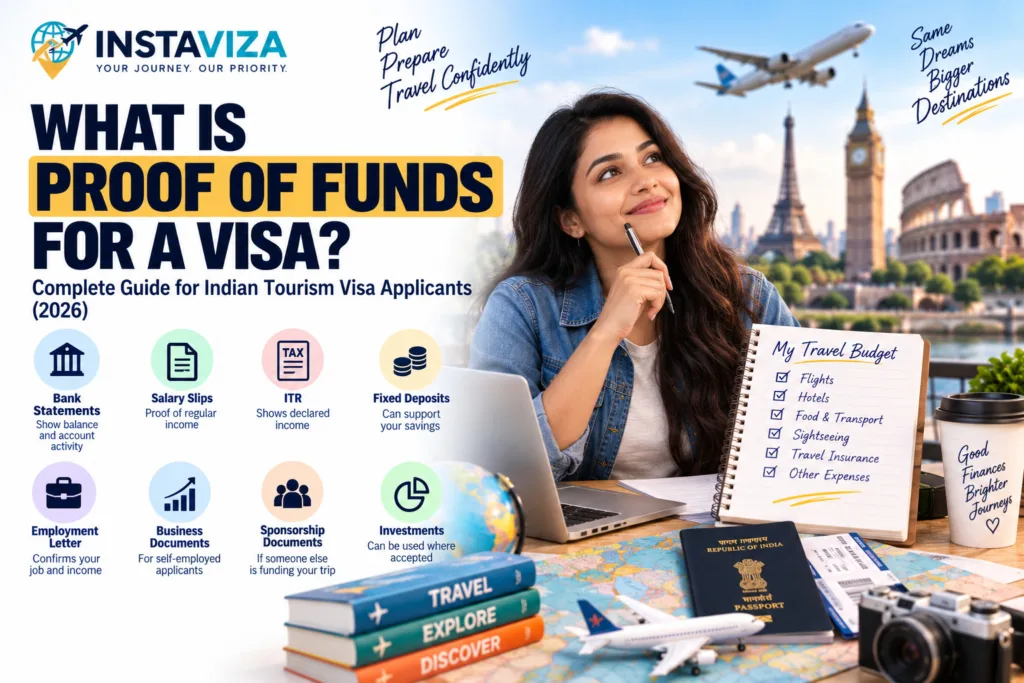
Your financial position can be demonstrated through a combination of documents such as:
- Bank statements
- Salary slips
- ITR
- Fixed deposits
- Employment documents
- Business financial records
- Investment records, where relevant
- Sponsorship documents
The exact requirements depend on the destination and your individual circumstances.
For example, Schengen visa rules require applicants to demonstrate sufficient means of subsistence for the intended stay and return journey, while proof of sponsorship can also constitute evidence in appropriate cases.
For US visitor visas, applicants may be asked for evidence of their ability to pay the costs of the trip, while another person may cover some or all expenses if the applicant cannot do so.
So proof of funds isn’t about finding a magic bank balance.
It’s about showing that your trip is financially realistic.
What Does “Proof of Funds” Mean?
Proof of funds means evidence showing that you have sufficient and legitimate financial resources to support your proposed trip.
Depending on the destination, this may involve demonstrating money available for:
- Accommodation
- Food
- Local transportation
- Sightseeing
- Return travel
- Other reasonable expenses
For Schengen applications, the EU visa framework specifically refers to sufficient means for the duration of the intended stay and the return journey. EUR-Lex
Is Proof of Funds the Same as Bank Balance?
No.
This is one of the most common misconceptions.
Your bank balance is only one part of your financial picture.
For example:
Bank balance: ₹5 lakh
Monthly income: ₹1 lakh
Trip cost: ₹2 lakh
The complete picture is more informative than simply saying:
“I have ₹5 lakh.”
A visa authority may consider your income, savings, transaction history and proposed travel expenses together.
What Documents Can Be Used as Proof of Funds?
There isn’t one universal document that every country accepts.
Depending on the destination and your circumstances, proof of funds can include:
Bank Statements
These can show:
- Current balance
- Regular income
- Transactions
- Savings
- Account activity
Salary Slips
Useful for salaried applicants to demonstrate regular employment income.
ITR
Can help establish declared income and tax history where relevant.
Fixed Deposits
Can demonstrate accumulated savings where accepted and relevant.
Business Financial Documents
Business owners may use appropriate financial statements, business bank statements and other business records.
Sponsorship Documents
If another person is paying for the trip, the sponsor’s financial documents may form part of the proof of funds.
How Much Money Do You Need to Show?
There is no universal amount for every tourist visa.
Different destinations use different methods of assessing sufficient funds.
For Schengen applications, individual Member States set reference amounts, and the assessment takes account of factors such as the intended length and purpose of the stay and the reliability of the financial resources presented.
The EU’s 2026 publication, for example, lists country-specific reference amounts rather than one single amount applicable across all destinations.
That’s why advice such as:
“You need ₹5 lakh for every tourist visa”
is misleading.
The right amount depends on your actual trip.
How Should You Calculate Your Required Funds?
A practical way to plan is to estimate:
Flights + accommodation + food + local transportation + activities + other expected expenses
Then consider your normal financial commitments.
For example:
Return flights: ₹80,000
Hotels: ₹70,000
Food and transport: ₹40,000
Activities: ₹30,000
Estimated trip cost:
₹2,20,000
Your financial documents should reasonably explain how this trip will be funded.
This isn’t a visa formula. It’s simply a sensible way to prepare your finances.
Does a Higher Bank Balance Mean a Stronger Visa Application?
Not necessarily.
A high balance by itself doesn’t guarantee a visa.
Imagine two applicants:
Applicant A
- Stable monthly income
- ₹4 lakh genuine savings
- Seven-day trip costing ₹1.5 lakh
- Normal bank activity
Applicant B
- Low regular income
- ₹12 lakh deposited shortly before applying
- No clear source
- Very expensive proposed trip
Applicant B’s larger balance doesn’t automatically make the application stronger.
The source and consistency of the funds can matter.
What If You Have a Large Recent Deposit?
A large deposit isn’t automatically a problem.
It could come from a legitimate source such as:
- Property sale
- Vehicle sale
- Investment redemption
- FD maturity
- Business payment
- Family support
If the transaction is significant, keep relevant evidence showing its genuine source.
UK visitor guidance specifically says financial evidence should demonstrate access to funds and their origin, and caseworker guidance states that declared income and large account deposits should correlate with the evidence submitted.
Can Fixed Deposits Be Used as Proof of Funds?
Potentially, yes.
A fixed deposit can demonstrate accumulated savings where the destination accepts it as financial evidence.
However, an FD and a savings account are not identical.
A savings account may show money that is readily accessible and regular transaction activity.
An FD may demonstrate longer-term savings.
Whether the FD counts toward the funds you are expected to demonstrate depends on the destination’s requirements and the accessibility of the money.
Can Investments Be Used as Proof of Funds?
Potentially, depending on the destination.
Investments can include:
- Mutual funds
- Shares
- Bonds
- Other financial assets
However, don’t automatically assume that the value of an investment is treated in the same way as cash in a bank account.
Some investments can fluctuate in value or may not be immediately accessible.
Always follow the destination-specific financial requirements.
Can Someone Else Provide Your Proof of Funds?
Yes, in certain circumstances.
For example, your trip may be funded by:
- Parents
- Spouse
- Family member
- Other eligible sponsor
The EU Schengen visa framework specifically recognises proof of sponsorship as potentially constituting evidence of sufficient means of subsistence.
For US visitor visas, the State Department also says an applicant who cannot cover all trip costs may show evidence that another person will cover some or all of the costs.
The sponsor’s relationship and financial circumstances may also need to be documented.
What Is Proof of Funds for a Student?
Students may not have independent income.
In such cases, the financial evidence may come primarily from a parent or another legitimate sponsor.
Depending on the destination, this may include:
- Sponsor letter
- Parent’s bank statement
- Parent’s ITR
- Salary slips
- Employment letter
- Relationship proof
- Student documents
The exact checklist depends on the country.
What Is Proof of Funds for a Homemaker?
A homemaker may not have personal employment income.
If the spouse is paying for the holiday, the application can explain that the trip is being financially supported by the spouse.
The sponsor’s financial documents can then be used where required.
The applicant doesn’t need to invent income just to make the application look stronger.
What Is Proof of Funds for a Self-Employed Applicant?
Self-employed applicants often have different financial records from salaried employees.
Depending on their profession and destination, they may provide:
- Personal bank statements
- Business bank statements
- ITR
- Business registration
- GST documents, where applicable
- Financial statements
- Invoices
- Contracts
The important thing is to accurately distinguish:
Business money vs personal money.
A business’s turnover isn’t automatically personal disposable income.
Can Cash Be Used as Proof of Funds?
Some countries may recognise cash or other financial instruments in certain circumstances, but visa applications normally rely heavily on documented financial evidence.
For example, Schengen border rules allow means of subsistence to be assessed through various forms of funds and financial instruments, subject to the applicable rules. EUR-Lex
For a visa application from India, however, don’t assume that simply carrying cash or showing cash at home is an adequate substitute for the documents requested by the consulate.
A documented financial history is usually much easier to assess.
Can Credit Cards Count as Proof of Funds?
This depends on the destination and the exact requirement.
Some entry rules can consider credit available to a traveller when assessing means of subsistence. EUR-Lex
But a credit card should not automatically be treated as a replacement for the financial evidence specifically requested in a visa application.
Always follow the official checklist.
Proof of Funds for Schengen Visa
Schengen applications are one of the most common examples where financial proof matters.
The EU Visa Code requires applicants to provide evidence of sufficient means for:
- The intended stay
- Return journey
It also allows proof of sponsorship and/or private accommodation to contribute to the evidence of sufficient means.
The amount is not identical across all Schengen destinations.
Individual Member States use their own reference amounts, and current EU publications list country-specific figures.
So don’t use a generic “Schengen bank balance” figure without checking the country you’re applying through.
Proof of Funds for a UK Tourist Visa
UK visitor applications focus on whether applicants have sufficient funds for the proposed visit and whether the financial evidence is credible.
The supporting-document guidance emphasises evidence showing access to funds and their origin.
This means your:
income + savings + bank activity + travel costs
should form a coherent financial picture.
There isn’t one universal bank-balance figure that applies to every UK visitor.
Proof of Funds for a USA Tourist Visa
US visitor visa applicants may be asked to provide evidence demonstrating their ability to pay the costs of the trip.
The State Department also notes that employment and family ties can help demonstrate the applicant’s circumstances and that another person can cover some or all travel costs when applicable. Travel.state.gov
Again, there isn’t one universal bank balance that applies to every applicant.
Does Proof of Funds Guarantee Visa Approval?
No.
Financial capacity is only one part of a tourist visa application.
Depending on the destination, the authority may also consider:
- Purpose of travel
- Employment or business
- Travel history
- Family circumstances
- Accommodation
- Itinerary
- Intention to leave
- Overall credibility
For example, Schengen rules specifically require authorities to assess the applicant’s intention to leave before the visa expires, alongside other conditions. EUR-Lex
What Makes Proof of Funds Stronger?
Good financial evidence is generally:
Genuine
The money actually belongs to you or your legitimate sponsor.
Consistent
Your bank activity, income and other documents make sense together.
Sufficient
The funds reasonably support the proposed trip.
Explainable
Large or unusual transactions can be supported when necessary.
Relevant
You submit documents that actually apply to your circumstances.
Common Mistakes With Proof of Funds
Chasing a Magic Number
There is no universal bank balance for every tourist visa.
Making Last-Minute Deposits
Large unexplained deposits can create questions.
Borrowing Money Temporarily
Don’t create a temporary financial profile for the application.
Showing Only a Bank Balance
Your source of income and financial history may also matter.
Hiding Sponsorship
If someone else is paying, explain it honestly.
Confusing Turnover With Personal Income
Business revenue and personal funds are different.
Using Fake Documents
Never fabricate financial evidence.
How to Prepare Proof of Funds for Your Visa
Before submitting your application:
1. Check the official financial requirements.
2. Calculate the realistic cost of your trip.
3. Collect the required bank statements and income documents.
4. Add FD, investment or sponsor documents where relevant.
5. Review large or unusual transactions.
6. Keep supporting evidence for legitimate sources of funds.
7. Make sure your financial information is consistent across the application.
Proof of funds for a visa is not simply a bank balance.
It is the overall evidence that demonstrates you can genuinely support your proposed trip or have legitimate financial support available.
Your financial picture may include:
Bank statements + income + savings + FD + investments + sponsorship
depending on your circumstances and the destination.
The best approach isn’t to try to make your bank account look as large as possible.
It’s to provide a genuine, understandable and well-supported financial picture.
Requirements vary significantly between countries, so always check the current official requirements before applying.
If you need help preparing your tourist visa financial documents, Instaviza assists Indian travellers with tourist visa applications for 40+ countries.
WhatsApp: 9988552050
Website: www.instaviza.com
Frequently Asked Questions
Proof of funds is financial evidence showing that you can support the costs of your proposed trip or have legitimate financial support available.
A bank statement can be an important form of proof of funds, but some destinations may require additional evidence of income, savings or sponsorship.
There is no universal amount. Requirements depend on the country, length of stay, travel costs and your circumstances.
A fixed deposit may be accepted as supporting financial evidence in some circumstances, subject to the destination’s requirements.
Yes, where sponsorship is permitted. Their financial and relationship documents may be required.
In many situations, yes. The sponsor’s financial ability and relationship with the applicant may need to be documented.
Potentially, but their treatment can vary. Don’t assume an investment automatically counts as immediately available cash.
No. Financial evidence is only one part of the overall application.
A legitimate large deposit isn’t automatically a problem, but you should be able to explain its source if required.
Business financial records may be relevant, but business turnover shouldn’t automatically be treated as personal travel funds.
No. Each destination has its own rules and financial assessment process.
Instaviza provides tourist visa assistance and documentation guidance for Indian travellers applying to 40+ countries.

Author: Visa & Travel Desk – Instaviza
The Visa & Travel Desk at Instaviza is a team of experienced visa documentation specialists and travel consultants who track global immigration policies, embassy announcements, airline advisories, and international travel regulations affecting Indian travellers. With years of experience assisting Indian passport holders with tourist visas, passport services, and travel insurance, Instaviza is committed to publishing accurate, reliable, and up-to-date travel information. Content published under Instaviza’s Editorial Policy.